
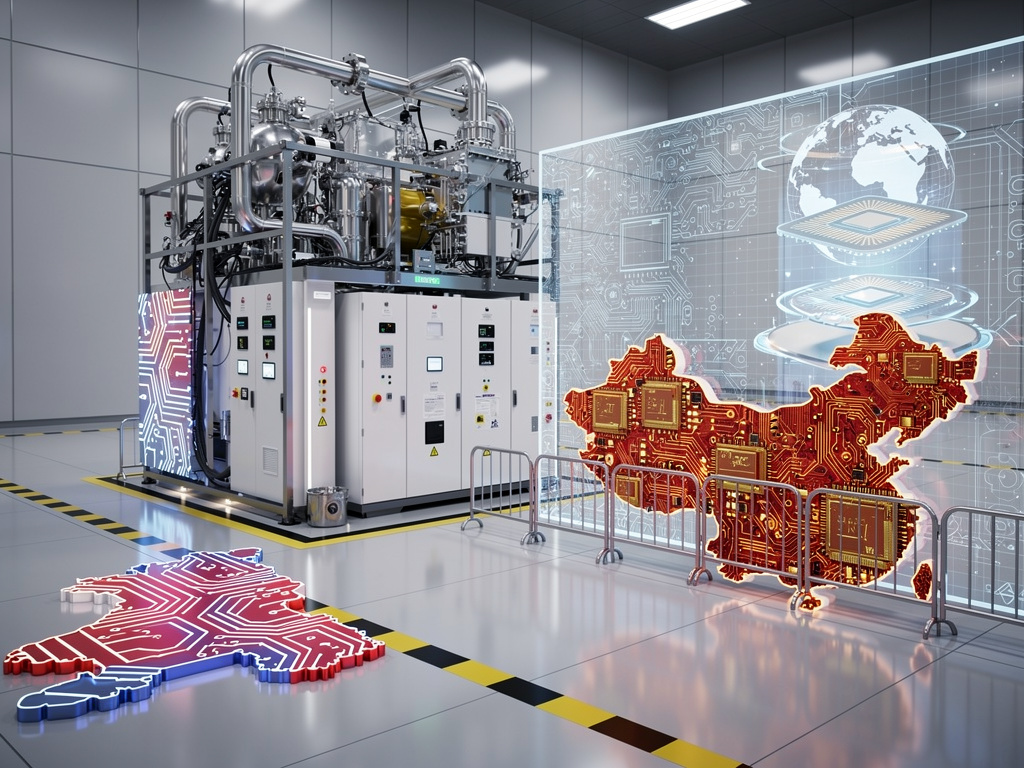
The Financial Times reported last month on a significant development in the semiconductor sector that highlights growing tensions between national security priorities and commercial interests. The story centers on ASML, the Dutch company that dominates the market for extreme ultraviolet lithography machines essential to producing the most advanced computer chips. New restrictions from the Netherlands have forced ASML to halt shipments of its most sophisticated equipment to Chinese customers, marking another step in the escalating technological competition between the United States and China.
The decision stems from updated export controls that took effect in early September. These rules specifically target the latest versions of ASML’s twinscan NXT:2050i and 2100i systems, machines capable of producing chips at the 3-nanometer level and beyond. Industry analysts estimate the blocked shipments could represent several hundred million euros in lost revenue for ASML over the coming quarters. The restrictions align with similar measures already implemented by the United States and Japan, creating a coordinated effort among key allies to limit China’s access to the most advanced semiconductor manufacturing technology.
This situation reflects years of mounting concerns about how advanced chips might support military modernization efforts in China. American officials have repeatedly expressed worry that processors manufactured with the most sophisticated equipment could enhance capabilities in artificial intelligence, supercomputing, and missile guidance systems. The Dutch government, after extensive consultations with both American and European partners, determined that national security considerations outweighed the economic benefits of continued exports.
ASML occupies a unique position in the global semiconductor supply chain. The company holds roughly 90 percent of the market for lithography systems, the machines that project circuit patterns onto silicon wafers during chip production. Its extreme ultraviolet technology represents the pinnacle of a decades-long progression in miniaturization that has followed Moore’s Law with remarkable consistency. Without access to these systems, Chinese manufacturers face substantial obstacles in developing chips that match the performance of those produced by Taiwan Semiconductor Manufacturing Company or Samsung.
The immediate effects on Chinese semiconductor companies appear mixed. Firms like SMIC have made notable progress in recent years, successfully producing 7-nanometer chips despite existing restrictions. However, moving beyond that threshold without EUV equipment presents formidable technical challenges. Industry experts suggest that Chinese producers might need to rely on older deep ultraviolet systems combined with multiple patterning techniques, approaches that reduce yields and increase costs significantly.
This development occurs against a backdrop of massive Chinese investment in domestic semiconductor capabilities. Beijing has poured hundreds of billions of dollars into initiatives designed to achieve technological self-sufficiency. The “Made in China 2025” strategy explicitly identified semiconductors as a priority area, leading to the creation of numerous state-backed funds and research programs. While these efforts have yielded some successes, particularly in legacy chip production, the gap in cutting-edge manufacturing remains substantial.
The restrictions also highlight the complex interdependence of the global technology supply chain. Although ASML is based in Veldhoven, Netherlands, many of its critical components come from suppliers across Europe, the United States, and Asia. The company’s EUV systems incorporate mirrors from German optics specialist Zeiss, lasers from American companies, and specialized materials from Japanese firms. This intricate web of international collaboration makes unilateral export controls particularly challenging to implement effectively.
European perspectives on these restrictions reveal some internal divisions. While the Netherlands has aligned with American security concerns, other European nations express greater hesitation about measures that might damage commercial relationships with China. Germany, home to numerous automotive and industrial firms with substantial Chinese market exposure, has advocated for a more measured approach. French officials have similarly emphasized the need to balance security considerations with economic realities.
The financial impact on ASML extends beyond the immediate lost sales. The company has maintained that its long-term growth prospects remain strong despite these restrictions. Management points to robust demand from customers in Taiwan, South Korea, and the United States as evidence that the Chinese market, while important, does not represent an existential threat to the business. ASML has also benefited from increased investment in semiconductor manufacturing in Western countries, driven partly by government subsidies aimed at reducing dependence on Asian production.
Taiwan Semiconductor Manufacturing Company stands to gain considerably from these developments. As the primary manufacturer of advanced chips for Apple, Nvidia, and other technology leaders, TSMC continues to operate at the forefront of process technology. The company’s Arizona fabrication facility, supported by American government incentives, represents one example of how Western nations are attempting to bring more advanced manufacturing closer to home. Similar initiatives in Europe, including Intel’s massive investment in Germany, further illustrate this trend toward regionalization of semiconductor production.
Chinese responses to the restrictions have followed predictable patterns. State media has characterized the moves as evidence of Western technological containment, while simultaneously emphasizing China’s determination to overcome such barriers through domestic innovation. The government has accelerated efforts to support local equipment manufacturers like Shanghai Micro Electronics Equipment, though these firms remain years behind ASML in technological sophistication.
The situation also raises questions about the effectiveness of export controls in an industry characterized by rapid innovation and complex global networks. History suggests that determined actors can often find ways around restrictions, whether through smuggling, third-country transshipments, or accelerated domestic research programs. The Soviet Union developed sophisticated military technologies despite Western export controls during the Cold War, though at considerable cost and with significant time delays.
Academic researchers have documented how previous rounds of restrictions have sometimes accelerated innovation in targeted countries rather than preventing it. When Japan restricted exports of machine tools to the Soviet Union in the 1980s, Soviet engineers developed alternative approaches that eventually narrowed the technological gap. Similar dynamics might play out in the current semiconductor competition, though the complexity of modern chip manufacturing makes direct comparisons difficult.
Industry leaders have expressed concern about the broader implications of these escalating restrictions. Many worry that fragmenting the global semiconductor market could lead to reduced efficiency, higher costs, and slower overall technological progress. The Semiconductor Industry Association, representing American companies, has advocated for carefully calibrated policies that protect genuine security interests without unnecessarily disrupting commercial activities.
The Dutch decision also reflects evolving understandings of what constitutes dual-use technology. Traditional export control regimes focused primarily on items with obvious military applications, such as weapons systems or encryption hardware. Modern semiconductors blur these distinctions because the same processors can power both consumer smartphones and advanced weapons systems. This convergence of civilian and military applications complicates policy decisions considerably.
Looking ahead, the semiconductor industry faces continued uncertainty regarding future restrictions. American officials have signaled their intention to maintain pressure on allies to align export policies, while Chinese entities continue investing heavily in alternative technologies. Quantum computing, advanced materials science, and novel chip architectures all represent potential avenues for circumventing traditional lithography limitations.
The human element in this technological competition deserves attention as well. Thousands of highly skilled engineers and researchers work at ASML and its suppliers, many of whom have collaborated with Chinese counterparts on various projects over the years. These professional relationships, built on shared scientific curiosity rather than national allegiance, now face strain from geopolitical pressures. Similar tensions affect universities and research institutions where international collaboration has long been the norm.
Economic analysts project that the global semiconductor market will continue expanding substantially over the coming decade, driven by artificial intelligence, 5G networks, electric vehicles, and countless other applications. Within this growth, the competition for technological supremacy between major powers will likely intensify rather than diminish. Countries that can maintain leadership in semiconductor manufacturing will enjoy considerable economic and strategic advantages.
The ASML restrictions represent one chapter in a much larger story about how nations balance security concerns with the benefits of global economic integration. As technology becomes increasingly central to both prosperity and power projection, governments worldwide are reassessing their approaches to critical supply chains. The outcomes of these policy choices will shape not only the semiconductor industry but also the broader contours of international relations in the twenty-first century.
For ASML specifically, the coming months will test the company’s ability to manage relationships with Chinese customers while complying with tightened export regulations. The firm has indicated it will continue supplying older systems and providing maintenance for previously delivered equipment, maintaining some level of engagement with the Chinese market. This nuanced approach reflects the complicated reality of operating in an industry where commercial interests, technological leadership, and geopolitical considerations increasingly intersect.
Chinese semiconductor firms, meanwhile, will likely accelerate their efforts to develop domestic alternatives to restricted technologies. While complete self-sufficiency appears unrealistic in the near term, incremental progress in specific areas could reduce vulnerabilities over time. The question remains whether these efforts can proceed quickly enough to meet the country’s ambitious economic and technological goals.
The situation serves as a reminder that in strategic technologies, market forces alone do not determine outcomes. Government policies, national security considerations, and international alliances play equally important roles in shaping industry development. As the competition between major powers continues, the semiconductor sector will remain at the center of debates about globalization, technological leadership, and economic security. The coming years will reveal how effectively different nations can balance these competing priorities while maintaining the innovation that has characterized the industry for decades.


 WebProNews is an iEntry Publication