
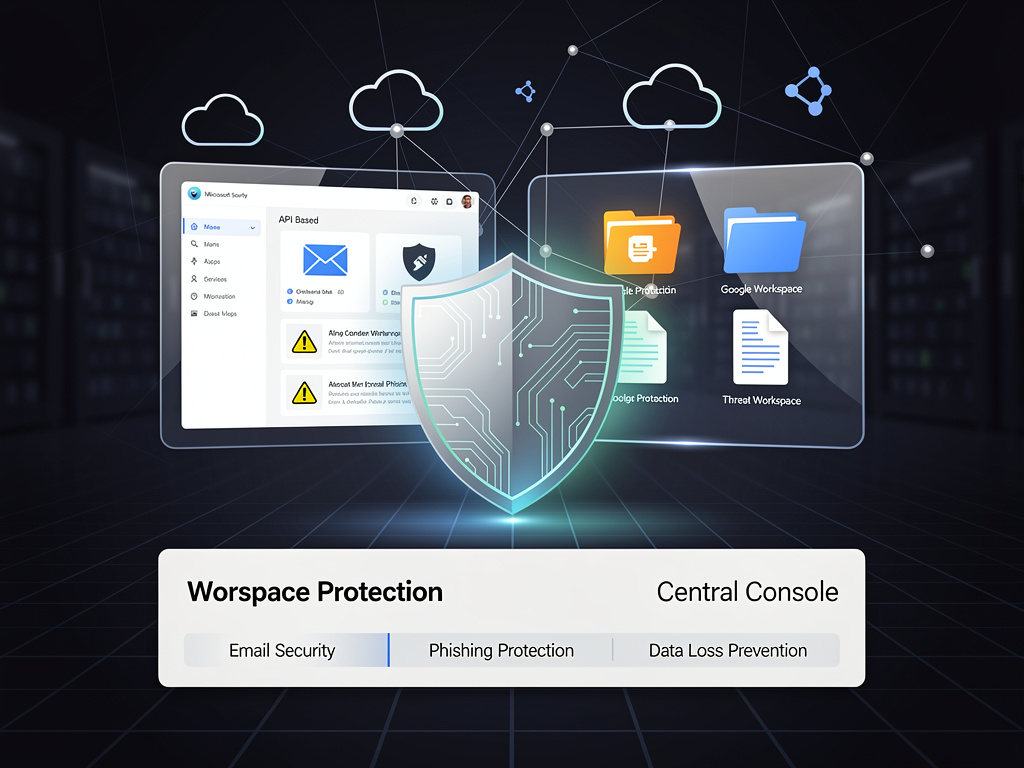
Sophos, the British cybersecurity firm known for its endpoint protection and managed detection and response services, has launched a new product called Sophos Workspace Protection — a move that signals the company’s ambition to address a widening vulnerability gap that exists as organizations increasingly adopt cloud-based productivity tools and hybrid work models.
The product, announced in late June 2025, is designed to protect cloud workspaces — specifically Google Workspace and Microsoft 365 environments — from phishing, business email compromise, malware delivery, and data loss. According to Sophos’s official blog, the offering integrates directly with these platforms via API, providing an additional layer of security that sits on top of the native protections offered by Google and Microsoft.
Why Native Cloud Security Isn’t Enough
The premise behind Sophos Workspace Protection is straightforward but significant: the default security controls built into Microsoft 365 and Google Workspace, while improved over the years, still leave substantial gaps. Sophos points to data showing that email remains the number-one vector for cyberattacks, with phishing and business email compromise (BEC) accounting for billions of dollars in losses annually. The FBI’s Internet Crime Complaint Center reported that BEC schemes alone cost organizations more than $2.9 billion in 2023, a figure that has continued to climb.
According to the Sophos blog post, the company’s threat intelligence indicates that attackers are becoming more sophisticated in how they craft phishing emails, often using AI-generated content that bypasses traditional signature-based detection. The new product uses Sophos’s own AI and machine learning models, combined with threat intelligence from SophosLabs and the Sophos X-Ops research team, to identify and block threats that slip past built-in platform defenses.
What Sophos Workspace Protection Actually Does
At a technical level, Sophos Workspace Protection connects to Microsoft 365 and Google Workspace through API integrations. This means it does not require mail flow changes such as MX record modifications — a notable distinction from older secure email gateway (SEG) approaches that required rerouting email traffic. The API-based approach allows the product to scan emails post-delivery, quarantine suspicious messages, and provide administrators with visibility into threats across their cloud workspace environment.
The product covers several threat categories. For email, it provides anti-phishing, anti-malware, and anti-spam capabilities, along with impersonation detection designed to catch BEC attempts where attackers pose as executives or trusted partners. It also includes data loss prevention (DLP) features that can identify sensitive information — such as Social Security numbers, credit card data, or proprietary documents — being shared inappropriately via email or cloud storage. As described by Sophos, the product extends beyond email to cover files stored in cloud drives like OneDrive, SharePoint, and Google Drive, scanning for malware that may have been uploaded or shared within the organization.
The Managed Service Provider Angle
One of the more strategically interesting aspects of the launch is its clear orientation toward managed service providers (MSPs). Sophos has long cultivated a channel-first business model, and Workspace Protection fits squarely into that strategy. The product is managed through Sophos Central, the company’s unified management console, which MSPs already use to administer endpoint protection, firewall, and MDR services for their clients.
This consolidation matters. MSPs serving small and mid-sized businesses (SMBs) have been under increasing pressure to offer comprehensive security coverage without multiplying the number of vendor dashboards they must monitor. By adding workspace protection to the same console that handles endpoint and network security, Sophos is making a play to become a single-pane-of-glass provider for MSPs. The company explicitly states in its announcement that the product is designed to be easy to deploy and manage, with policies that can be applied across multiple customer tenants from a single interface.
A Crowded Market With High Stakes
Sophos is entering a competitive field. Established players like Proofpoint, Mimecast, and Abnormal Security have built significant businesses around cloud email security. Microsoft itself has invested heavily in its Defender for Office 365 product, which provides advanced threat protection for Microsoft 365 customers willing to pay for premium licensing tiers. Google has similarly enhanced its native protections within Workspace.
The API-based approach Sophos is taking mirrors what companies like Abnormal Security and Material Security have popularized in recent years — the so-called “integrated cloud email security” (ICES) model. Gartner has noted the growing adoption of ICES solutions as organizations move away from traditional SEGs. The analyst firm has projected that by 2025, a significant percentage of enterprises would adopt API-based email security supplements, a prediction that appears to be playing out. Sophos’s entry validates this market trend while also bringing the approach to the MSP and SMB segments, where adoption has lagged behind enterprise deployments.
The Broader Cybersecurity Consolidation Trend
Sophos’s move also reflects a broader industry trend toward platform consolidation. Over the past several years, CISOs and IT leaders have expressed growing frustration with vendor sprawl — the accumulation of dozens of point security products, each with its own console, licensing model, and support structure. Research from organizations like the Ponemon Institute has shown that the average enterprise uses more than 40 security tools, a number that creates operational complexity and can actually degrade security outcomes by generating alert fatigue.
Major cybersecurity vendors have responded by expanding their platforms. CrowdStrike has moved aggressively beyond endpoint detection into identity protection, cloud security, and log management. Palo Alto Networks has pursued a “platformization” strategy under CEO Nikesh Arora, consolidating multiple security functions under its Cortex and Prisma brands. Sophos, while smaller than these publicly traded giants, is following a similar logic within its target market of MSPs and mid-market enterprises. The addition of workspace protection fills a gap that previously required customers to purchase and manage a separate product from a different vendor.
Threat Intelligence as a Differentiator
Sophos is leaning on its threat research capabilities as a key differentiator. The company’s X-Ops team, which combines researchers from SophosLabs, Sophos SecOps, and Sophos AI, regularly publishes detailed threat reports and has gained industry recognition for its investigations into ransomware groups and nation-state actors. The company has argued that this intelligence pipeline — which feeds data from millions of endpoints, firewalls, and now cloud workspaces — creates a feedback loop that improves detection accuracy across all its products.
This argument has merit. One of the persistent challenges in email security is the speed at which attackers rotate infrastructure, create new phishing domains, and modify payloads to evade detection. A vendor with a large and diverse telemetry base can, in theory, identify emerging threats faster than one with a narrower view. Sophos claims that its workspace protection product benefits from the same threat intelligence that powers its MDR service, which monitors more than 28,000 organizations worldwide. Whether this translates into measurably better detection rates than competitors will ultimately be tested in the field and in independent evaluations.
Pricing and Availability Signal Market Positioning
Sophos has made Workspace Protection available immediately through its existing channel partner network. While the company has not publicly disclosed specific per-user pricing, the product’s positioning within Sophos Central and its availability through MSP-focused licensing programs suggests it will be priced competitively for the SMB market. This is consistent with Sophos’s overall strategy since its acquisition by Thoma Bravo in 2020 — the private equity firm has pushed the company to grow recurring revenue through subscription-based products sold via the channel.
The timing of the launch is also notable. The first half of 2025 has seen a surge in AI-powered phishing campaigns, with multiple security vendors reporting significant increases in the volume and sophistication of email-borne threats. Organizations that previously relied solely on native Microsoft or Google protections are increasingly recognizing the need for supplemental security layers. Sophos is positioning Workspace Protection as the logical addition for organizations that already trust the company with their endpoint and network security.
What This Means for IT Leaders and MSPs
For IT leaders evaluating their cloud security posture, the Sophos launch represents another data point in the ongoing shift toward integrated, API-based email and workspace protection. The key questions for prospective buyers will be familiar: How does detection efficacy compare to established players? How well does the product integrate with existing incident response workflows? And does the consolidation benefit of a single management console outweigh the potential trade-offs of choosing a less specialized solution?
For MSPs, the calculus may be simpler. If they are already managing Sophos endpoint protection and firewalls through Sophos Central, adding workspace protection to the same platform reduces operational overhead and creates an opportunity to expand recurring revenue per customer. The product’s success will likely depend less on whether it is the absolute best-in-class email security solution and more on whether it is good enough to justify the operational simplicity of consolidation — a trade-off that many MSPs have shown they are willing to make.


 WebProNews is an iEntry Publication