
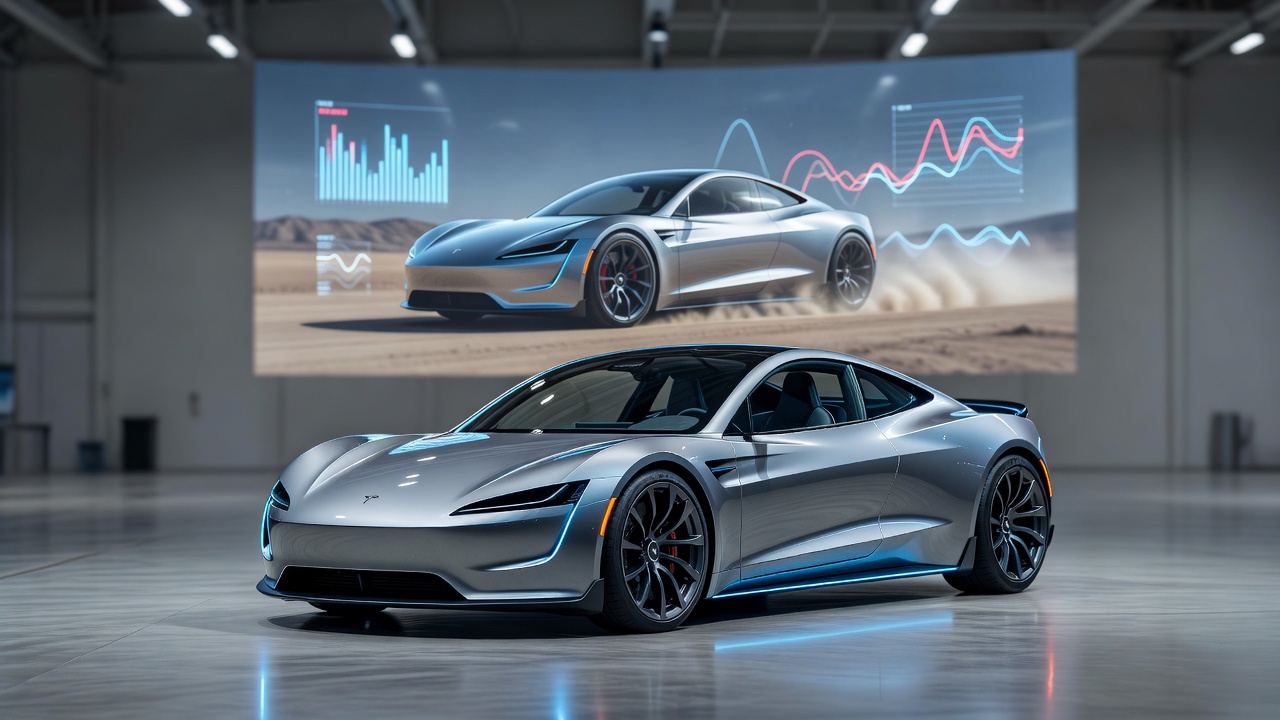
Update: Tesla held the reveal Thursday night, October 15, at SpaceX’s facility in Waco, Texas. The car ran 0-60 mph in 0.81 seconds in a test at the event, and Musk said, “We enter production in 2028,” Yahoo Finance reported. Read our coverage of the reveal. The preview below ran on October 14.
Tesla will stream the production-ready reveal of its next-generation Roadster at 7:55 p.m. Central on Thursday, October 15, from SpaceX’s Rocket Development and Testing facility in Waco, Texas. Elon Musk first showed the car in November 2017 and promised production in 2020. Nearly nine years later, Tesla hasn’t delivered a single one, as Electrek pointed out on October 13.
The event was supposed to happen October 1. Tesla called it off on September 28, saying it had been tracking the weather with local meteorologists and that the show “can only be held outdoors.” Stormy weather would likely have hampered the car’s rumored hovering or flying ability, according to Yahoo Finance.
From 2017 promises to a thruster stunt
The 2017 promises were big: 0-60 mph in 1.9 seconds, a top speed above 250 mph, up to 620 miles of range and a 200-kilowatt-hour battery pack, roughly the size of the one in GMC’s Hummer EV, Business Insider reported. Musk later promised an optional “SpaceX package” with cold-gas thrusters that would let the car “fly a little,” and he has since claimed 0-60 in under one second with the thrusters.
The teasers point to a redesign. A September image captioned “Go for launch” showed the car in a shaft of light with “10.01” at the bottom. It also showed a full-width rear light bar, and fans who brightened it found the hidden words “WHERE WE’RE GOING,” a Back to the Future nod to a car that doesn’t need roads. A later clip, introduced by Tesla vehicle engineering VP Lars Moravy at the end of the company’s Semi event, showed a full-width front light bar, autoevolution reported. Electrek said the teasers suggest Tesla’s angular “Cyber” styling.
Thursday’s show looks built around the thrusters. Electrek reported that the demo has been scaled back from “flying” to a short hover, and that the demo car is reportedly remote-operated and not street-legal. Whether regulators would ever allow thrusters on a road car is an open question.
Patent filings hint at other tricks. A fan-car patent describes pulling a vacuum under the car, which Electrek said could point to some upside-down driving. A separate application published September 24 shows a hidden active rear wing that can make up to 700 kg (about 1,543 pounds) of downforce, on a car that looks a lot like the new Roadster.
Nine years of slips
Electrek counts at least six production slips and seven unveil dates. Production moved from 2020 to 2021, 2022, 2023, 2024 and 2025, and then, in November 2025, to 2027 or 2028. The unveil slipped too. A demo planned for the end of 2025 became April 1, 2026, a date Musk said gave him “deniability,” and then late April. On the first-quarter earnings call it was “maybe in a month or so,” then late May or June, then August or later, then October 1 and now October 15.
Reservation holders have been waiting the whole time. In 2017 Tesla asked for a $50,000 deposit on the base car and $250,000 upfront for a Founders Series, Business Insider reported, and some big names have left the line; OpenAI CEO Sam Altman canceled his reservation. New buyers now put down $5,000, followed by a $45,000 wire transfer due within 10 days.
Tesla hasn’t said what the car will cost, though Yahoo Finance said it’s expected to exceed $250,000. When Tesla announced the 7:55 p.m. start time on X, Musk replied, “Timing is everything.” Longtime Tesla analyst Pierre Ferragu suggested the digits might relate to the price and floated $75,990.
A different EV market
“EVs exist today in a massively different environment than when the Roadster was introduced,” Ed Kim, president of AutoPacific, told WIRED. U.S. buyers had 15 EVs to choose from in 2017 and have nearly 90 today, according to Cox Automotive. But EV sales are now shrinking after the Trump administration reversed course on electric vehicles, and WIRED noted that Musk is the leading donor to a political party that last year eliminated EV buying incentives.
The hypercar end of the market has been especially rough. The Verge pointed out that the Rimac Nevera, Pininfarina Battista and Lotus Evija all struggled with low sales and weak demand, and that Mate Rimac has said his company had trouble selling its planned run of 150 Neveras. Lamborghini dropped its planned pure EV for an all-hybrid lineup. Tesla has also already beaten one of its old Roadster targets with another car: the Model S Plaid, released in 2021, had a claimed 0-60 time of 1.99 seconds, later confirmed by independent tests.
Tesla itself has moved on. Musk tells investors to think of it as a robotics and autonomy company and has said the Roadster will be the last Tesla built for human driving. The company recently ended production of the Model S and Model X to make room for its Optimus humanoid robots. In The Verge’s words, “the timing couldn’t be worse.”
Volume may not be the point. The Verge expects a limited-run car “where success is measured not by sales volume, but by scarcity,” and WIRED reported that Tesla is slated to start deliveries next year.
Electrek editor Fred Lambert, who holds two Roadster reservations, said what he wants to see Thursday is “a production car, a real price, a real start of production, and a straight answer on what happens to the 2017 reservations.”


 WebProNews is an iEntry Publication